Financial Planning and Financing Part I: Profitability Planning

Financial Planning: Translating Business Strategy into Economic Figures
In the first chapters of your business plan, you have already intensively analyzed the customer benefits of your project, developed a market analysis, created a marketing concept, looked at your competitors and much more. With the financial plan you will now complete your business plan. Now it's time to translate the assumptions you made earlier into business economic figures, i.e. your sales (sales volumes and prices) over the course of time, as well as your expenses e.g. personnel, interest or depreciation expenses, but also marketing expenses, etc. The financial plan of your business project is made up of various individual plans:
- The profitability planning: (also called profit and loss profit and loss statement, or P&L in short), with which you determine whether your project is also profitable, i.e. whether it will generate profits, and how long it will take until you can earn your own living from your business.
- The liquidity planning: with which you can determine the cash flows and you will be able to determine whether you will always be "solvent" (liquid) in the future.
- The investment planning: considers all those positions which have a rather rare character and are there for a longer time.
The results of the planning calculations are primarily of interest to you, because this is the only way you can be sure of the viability of your project. But also, your investors, e.g. credit institutes or investment partners or investment partners, would also like to have plausible demonstration of the feasibility of your business project by means of plausible figures. Despite the large number of figures that need to be determined, the creation of financial planning tables is much easier than it first appears. Experience shows, however, that start-ups often find it difficult to transform their plans into figures and tables.
Profitability Planning and the Profit and Loss (P&L) Account
Here you calculate whether your project is "profitable" in the long run. The profit and loss account (P&L) shows you whether you will make a profit or a loss in the period under consideration. The basic formula used is simple and reads:
Income - Expense = Profit (or Loss)
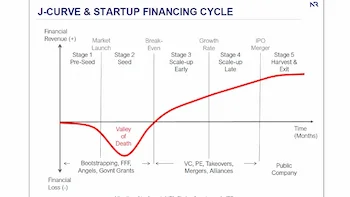
After you have planned all income and expense items you will probably find out that at the beginning of your self-employment you are more likely to record losses rather than profits. This will be the case for most entrepreneurs because they usually must make and spend money before they can charge their customers for their services for the first time. Like an athlete who can only jump over a bar with a running start, you need a running start for your company before you can show a profit.
The longer this period is, the higher the reported profit must be later, because from this you do not only pay your (imputed) entrepreneur's wage, but you also compensate the losses at the beginning of your activity. Furthermore, you also need the profit in order to reimburse credits and to build up operational reserves for future investments and for contingencies. Plan for a sufficiently long period, usually three years or more.
Projecting Revenue and Sales Turnover
For start-ups, almost all income comes from sales. The planning of their turnover presents for most of the start-ups their greatest challenge in the preparation of the business plan. Many do not really embrace this task, or they only guess their figures. While it is true that even with the best planning, you will never be able to predict exactly how your sales will develop. Nevertheless, you should have a clear idea of what is plausibly "feasible". You have already asked and answered this question in the business plan in the earlier chapters. You know how big the market potential is, i.e. what is theoretically possible. You have to earn your cost of goods sold. And finally, you will often find manufacturers' recommended prices in the trade, for example, which limits you. So, if you have only a narrow range for determining your prices, it is obvious that the success or failure of your business will rather the sales volumes you can achieve. So, plan especially carefully here. Please always remember: Plan only with net prices at this point!
Understanding Regular Business Expenses
In business management terms, "expenses" are the "consumption" of all goods and services in a given period. This refers to all items that occur with certain business activities with a certain degree of regularity and not just infrequently.
Variable Operating Expenses
These are expenses that are only incurred when your business is actually active. Essentially, these are: the cost of materials such as raw materials and supplies, merchandise, individual parts, components, etc., but also external services, commissions and the like. The cost of materials and/or services are usually calculated and presented as a percentage of sales in profitability planning.
Fixed Operating Expenses
In contrast to variable expenses, the fixed items are always incurred, irrespective of the sales. This does not mean, however, that they remain unchangeable because they will also change if the sales volume changes. For example, you need more staff if your turnover increases and you can no longer manage the work alone. This in turn entails further expense, because you will need office space, computers, desks, telephones, etc. for the new employees. Also, the effort is not evenly distributed throughout the year: many things are paid monthly, others only at certain times. For example, insurance are often paid in advance in January for the whole year, interest payments are often made at the end of the quarter.
Fixed expense items include the following items:
- Personnel expenses: Think about when you will hire which employees and consider that you must add the so-called non-wage labor costs to the gross wage costs that you spend on your employees. They are calculated from the half (parity) share of the social security contributions and amount to more than 21 percent of the gross wage costs in Germany. Take into account special payments, such as Christmas bonuses, if applicable.
- Interest expense: You usually have to pay interest on borrowed capital. You will only exactly know how high your actual financing requirements will be when you have prepared the liquidity plan. At the beginning of the planning, it is sufficient to calculate the interest for investments in a simplified way using the following formula: (Amount of investments minus equity = financing requirements) x 5%. Divide the obtained sum by 12 to get your monthly interest burden. After creating the liquidity plan, you should verify the interest data by asking for current rates.
- Working Capital Financing: You should also plan for the financing of working capital, e.g. to compensate for seasonal fluctuations. This is usually done by means of a so-called "current account credit" (overdraft facility). This is comparatively expensive and should be considered at the beginning of the planning at least with 125 € per month. (10.000 € x 15 %) = 1.500 €: 12 months = 125 € / month.
- Depreciation expense: If you become active entrepreneurially, you have to make acquisitions like office equipment, vehicles, or computers. In your P&L, only a fraction of the purchase price can be recognized as an operating expense per year, as the asset is used over a longer period. The "normal useful life" is defined by tax authorities in Amortization Tables (e.g., 3 years for a PC, 6 years for a car).
Allocating Other Operating Expenses
"Other operating expenses" are all those expenses incurred in the course of ordinary business activities that occur with a certain regularity and do not belong to materials, personnel, depreciation, or interest. These include: Rental expense, leasing, motor vehicle costs, license/patent fees, business insurance, marketing, travel, and consulting fees. Some items are easy to research; for others, get concrete offers. Also, keep in mind special startup-related expenses that occur only at the beginning (brokerage fees, deposits, renovation, legal fees for formation, and opening ceremony marketing). All these should be planned as expenses in the first month after formation.
Profit Management and Financial Scenario Analysis
Calculating Personal Profit Needs
Since your self-employment will probably be your only source of income, the first step is to determine how high your monthly expenses for your own lifestyle will be. With this you know what your self-employment must have at least "left over" as profit (or managing director's salary) so that you can live on it.
Scenario Analysis: Best Case vs. Worst Case (Black and White Painting)
The ideal is the additional draft of two scenarios: the best case, the ideal case of your planning, and a worst case, the unfavorable case of your planning (the worst case to be expected). Work out your chances and risks. Vary parameters such as price and sales to illustrate the impact on your planning. Determine the approximate time when the break-even point is reached. Show a potential investor that you assess the development of your company realistically and pragmatically.
Finalizing Your Financial Roadmap
Go through your entire business plan and decide whether and to what extent the assumptions you have made will be reflected in expenses and income. are reflected in expenses and income. If you are in doubt about the exact amount of expenses to be incurred, obtain cost estimates.
Critical Questions to Answer in This Chapter:
- Create a sales plan (volume plan) for the next three years. Consider how many products or services you will sell over time, taking into account capacity limits and seasonal fluctuations.
- Derive the net prices for your product or service based on your marketing chapter.
- Calculate your planned net sales from quantities and prices over time.
- What expenses will be incurred in the first three years? Name and justify the most important items.
- How high is your cost of materials and planned expenses for external services?
- Derive the personnel and wage costs, including ancillary wage costs.
- Take over the depreciation planning from your investment planning.
- How high do you estimate the interest expense for loans in the first three years?
- How high do you plan the other operating expenses?
- Include special expenses that (only) occur at the beginning (e.g. brokerage fee, renovation, outdoor advertising).
- Using the above information, prepare your budgeted profit and loss account (budgeted P&L) for the first three years on a monthly basis.
- How will your sales planning change if you change your assumptions? Create several scenarios ("best case", "worst case").
- At what point is the planned profit sufficient to live on?
Summary: Building Investor Confidence through Data
A well-prepared financial plan is the ultimate proof of a startup's viability. By meticulously calculating revenue turnover, differentiating between fixed and variable expenses, and conducting honest best/worst-case scenario analyses, founders can demonstrate a pragmatic grasp of their business's economic reality. This data-driven transparency not only helps in internal management but is essential for securing the trust and capital of professional investors and financial institutions.