The Blank Cursor Problem

From Chatbot Prompts to a Digital Workforce: The AI Architecture Shift for SMEs
There is a specific kind of fatigue I see in every boardroom right now. Let’s call it “Prompt Fatigue.”
You open ChatGPT. A blank cursor blinks at you.
You have to think: “What do I ask? How do I frame it? What context is missing?”
It feels like work. Because it is work.
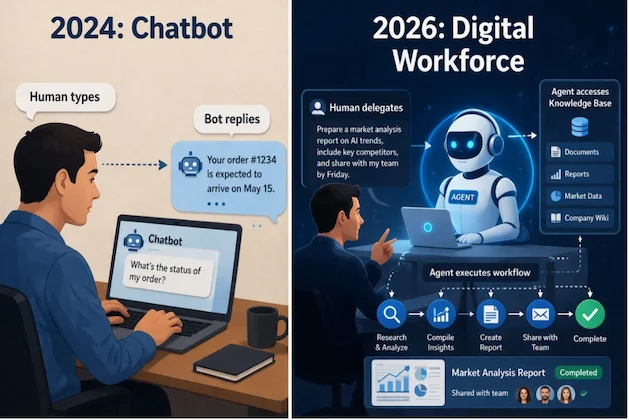
Here is the architectural truth nobody tells you: Using AI as a “chatbot” is like hiring a brilliant intern, wiping their memory every morning, and forcing you to re-explain the job from scratch.
That’s not leverage. That’s micromanagement.
If you want to scale in 2026, you have to stop “using” AI tools. You have to start hiring AI capabilities.
From Swiss Army Knife to Digital Org Chart
Most SMEs treat AI like a Swiss Army Knife, one generic tool for everything. You wouldn’t ask your CFO to write marketing copy. Yet we ask the same generic LLM to do both.
Smart founders are shifting their mindset. They aren’t building prompts; they are building a Digital Org Chart.
What Is a Digital Org Chart?
Instead of “using AI,” successful revenue architectures now have defined digital roles:
- The Proposal Architect for sales: An agent fed with your 50 best winning proposals and pricing logic. It doesn’t “write text”; it structures deals based on your winning patterns.
- The Support Triage for service: An agent connected to your help center that drafts answers for human review, adopting your specific tone of empathy.
- The Briefing Officer for strategy: An agent that scans market data and summarizes only what impacts your specific niche.
This isn’t sci-fi. This is available technology. The difference isn’t the software. The difference is the architecture.
Why Context Is the Missing Link in AI Adoption
Why do most AI pilots fail to reach this level? Because the AI doesn’t know who you are.
If you hire a human expert, the first thing you do is onboarding. You give them access to the Google Drive, the history, and the culture.
Most companies never “onboard” their AI.
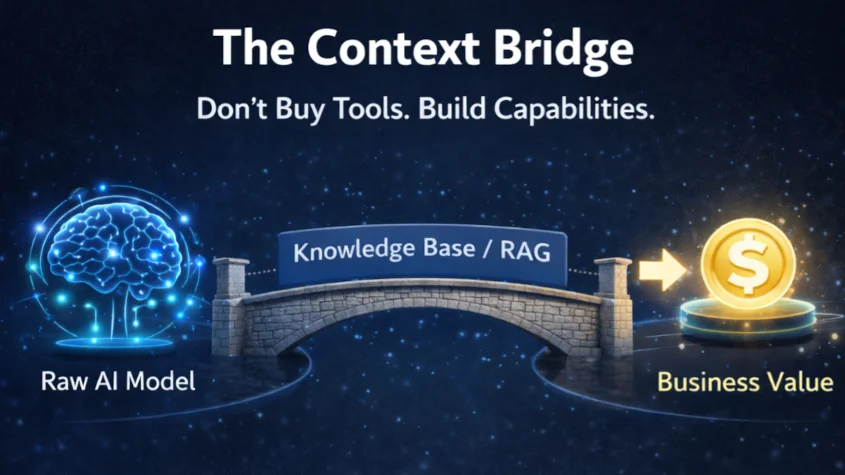
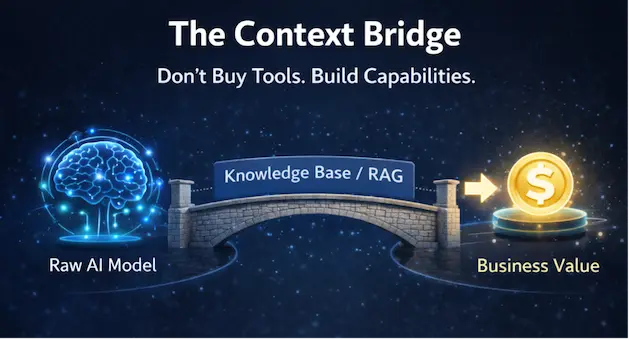
This is where the BRAINRISE architecture differs. We don’t just set up tools. We connect the Corporate Brain.
By using platforms like TextCortex, our preferred enablement partner for this program, we can connect your Knowledge Base, including your files, your history, and your tone, directly to the AI.
Suddenly, you aren’t prompting a generic robot. You are delegating to a system that knows:
- Your brand voice guidelines
- Your product specifications
- Your past strategic decisions
Without context, AI is a toy. With context, AI becomes a workforce.
How to Move from Prompting to Delegating
This shift, from “prompting” to “delegating,” requires a plan. You can’t just buy a license and hope for magic.
You need to identify:
- Which roles can be supported by digital agents?
- What knowledge do those agents need access to?
- How do you manage the output quality?
This is the core of our AI Thunder program.
We don’t just give you a login. In the AI Compass Call, we map your processes to identify exactly which “Digital Employees” you should hire first to get the biggest impact.
Then, we give you the keys: 60 Days of TextCortex Unlimited are included. So you can build, train, and test your first specialized agents immediately.

Write Your New AI Job Descriptions
The goal for 2026 isn’t to become a “Prompt Engineer.” The goal is to remain a CEO and build a better organization.
If you are ready to stop chatting and start building, let’s map your architecture.
Book Your 45-Minute AI Compass Call
Book your 45-minute AI Compass Call
It’s time to upgrade your workforce.