Why the Business Model Canvas Complements the Executive Summary

Using the Business Model Canvas for Your Executive Summary
There are different approaches to design the Executive Summary (ES) of your business plan. Besides purely textual forms, you can use graphical presentations. We are convinced that the "Business Model Canvas," developed by Alexander Osterwalder, provides an excellent summary of your business case.
As a preliminary stage to the business plan, this creative method for developing a business model from an idea is an ideal start. The basic segmentation of the "canvas" provides a robust basis for a supplementary presentation of the ES.
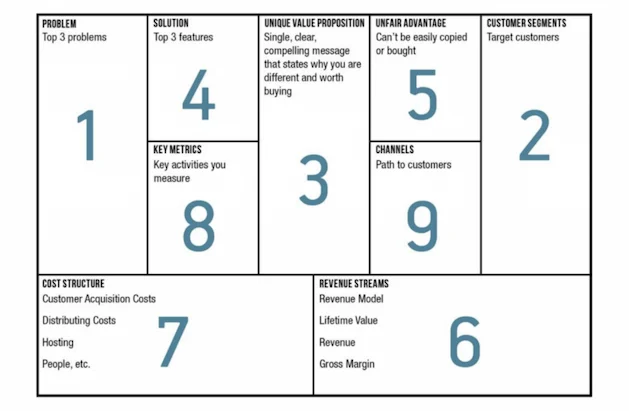
The Classical Business Model Canvas
Below is the traditional layout of the Business Model Canvas:
The Adapted K2MATCH Business Plan Matrix
We have slightly adapted the matrix to better support our recommended business plan structure and the Executive Summary specifically.
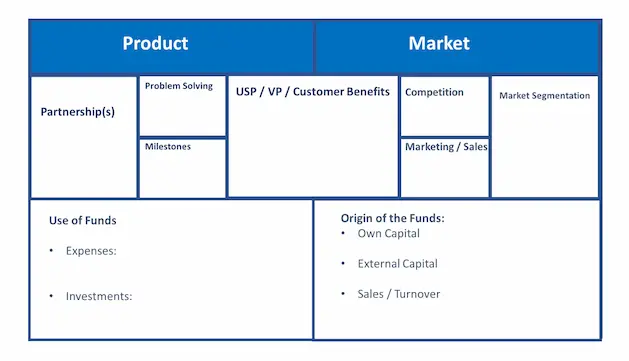
This overview summarizes all important information on a single page across nine fields. The left side contains information relating to your product or service, while the right side focuses on the market and customer relationships. The canvas should include core statements from your financial planning, giving readers a clear impression of your business model. Answer all points with just a few words or sentences—this creates the foundation for your elevator pitch.
The 9 Essential Components of Your Business Model
1. Strategic Partnerships
Which partners (strategic partners, cooperation partners, suppliers, etc.) are critical for your project's success?
2. Problem Solving
Which specific customer problem do you solve with your product or service?
3. Project Milestones
Which steps do you still have to master, and what is your timeline for implementation?
4. Unique Selling Proposition (USP) / Value Proposition
What is your unique selling proposition and the actual tangible benefit to the customer?
5. Primary Competitors
Who are your main competitors in the current market landscape?
6. Marketing and Sales
How do your products/services reach your customers, and how do you maintain communication with them?
7. Market Segmentation
Who are your target customers, how do you segment them, and what is the total addressable market size?
8. Use of Funds
How much capital do you estimate you will need for working capital and investments at the start of your journey?
9. Origin of Funds
Where do you expect the required funds to come from? Break this down into equity, outside capital, and sales revenues.