How to Present Opportunities & Risks to Investors

Strategic SWOT Analysis: Mastering Internal and External Business Factors
Your development and your scope of action depend to a large extent on your ability to seize opportunities, recognize risks at an early stage, and counter them effectively. To do this, it is essential to identify your organization's core strengths and weaknesses.
A SWOT analysis integrates a strengths-weaknesses analysis (internal) with an opportunities-threats analysis (external). It summarizes the critical results of internal process reviews and the findings of external market factors influencing the company.
The primary aim of a SWOT analysis is to evaluate how well your current strategy can succeed against specific environmental influences. Furthermore, it examines whether your specific capabilities are suitable for responding to rapid changes in the corporate landscape.
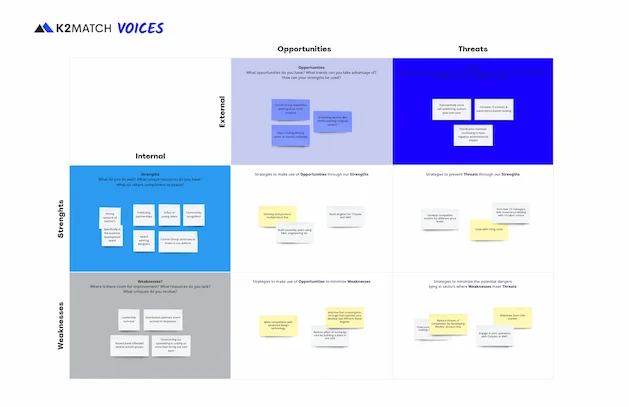
Critical Questions for Your SWOT Strategy
- What are the company's core competencies?
- Where does your company have a performance advantage over competitors?
- What are the company's primary development needs?
- What opportunities exist to create a competitive advantage or operate more profitably?
- Which trends could lead to uncalculated growth, and what measures are needed to serve them? Conversely, which trends could lead to profit losses, and what countermeasures are planned?
The History and Strategic Power of SWOT
The SWOT analysis was developed in the mid-1960s to help large organizations determine the strategic fit between internal capabilities and external possibilities. Originally, business policy professors at Harvard, George Albert Smith and C. Roland Christensen, began questioning if a firm's strategy truly matched its competitive environment.
A study at the Stanford Research Institute (SRI) involving 5,000 managers revealed that the gap between planning and accomplishment was often 35%. The issue wasn't the information quality, but the inability to reach a committed agreement on objectives. SWOT was created to make strategic decision-making explicit by categorizing factors as positive or negative across the present and the future.
SWOT Definitions: Internal vs. External Factors
- Strengths: Internal factors that make a firm more competitive than direct rivals.
- Weaknesses: Internal limitations or defects relative to direct competitors.
- Opportunities: External future factors that allow for an improved competitive position.
- Threats: External future factors that could reduce the firm's relative market position.
The Three-Phase SWOT Analysis Process
Phase 1: Detecting Strategic Issues
- Identify external issues (opportunities and threats) that management cannot directly influence.
- Identify internal issues (strengths and weaknesses) relevant to the firm's position.
- Analyze and rank external issues according to probability and impact.
- List key factors in the SWOT matrix that significantly impact long-term competitiveness.
Phase 2: Determining the Strategy
Identify the strategic fit between internal capabilities and the external environment. Formulate alternative strategies to address key issues and place them in the matrix:
- Ideal Mix: Combining internal strengths with external opportunities.
- Investment Risk: Addressing internal weaknesses through external opportunities.
- Adaptation: Using internal strengths to neutralize external threats.
- Worst-Case: When internal weaknesses meet external threats, radical changes like divestment may be required.
Phase 3: Implementation and Monitoring
- Develop a concrete action plan to implement the chosen strategy.
- Assign specific responsibilities and budgets.
- Monitor progress and restart the review process periodically.