How to Choose the Right CRM for Your Startup

Defining Customer Relationship Management (CRM) for Business Success
Customer relationship management is your company’s strategy for maintaining engagement with your clients and potential clients. The purpose is to personalize a business relationship, whether it’s B2B or B2C, in hopes that this personalized and strategic touch will result in more business.
What is a CRM? A Comprehensive Definition
What is customer relationship management and how should you choose the right CRM solution for your business? ‘Customer relationship management’ or ‘CRM’ for short, refers to the technology and processes that an organization uses to manage its contacts and relationships, both external and internal, such as:
- Email subscribers
- Sales leads
- Sales opportunities
- Customers
- Advocates
- Employees
Don’t be fooled by the word "customers" in the term: although one goal is to use this customer data to build and strengthen relationships, CRM can also be used to manage relationships with individuals at all touchpoints.
practice of customer relationship management includes guidelines for how direct interactions take place and also management of CRM tools for organizing and tracking all the relevant information you need to find prospects, nurture leads, close deals and retain customers, build stronger relationships, increase sales, create more personalized customer service and, overall, make processes more efficient.
Internally, a CRM could help salespeople automate their sales activities and managers track their team’s performance. With a CRM, you’ll know when to reach out to your sales leads, what to say and how to say it. CRMs basically optimize your process of interacting with your intended audience. The topic of customer relationship management and the challenge of selecting the right CRM system for your business can be intimidating.
We're going to dive into customer relationship management and help you understand how CRM software can help you build a foundation for sustainable business growth and management.
Integrating CRM Strategy with Modern Technology
Before going into the tangible benefits of a CRM tool, it’s important to understand the difference between CRM technology and CRM strategy.
In summary, the key difference is this:
CRM Technology: Acts as a central platform where primarily customer information can be organized, used, securely shared, and acquired. It provides functionality for pipeline management and reporting, as well as the ability to communicate and track all touchpoints with your contacts.
CRM Strategy: These are the processes that organizations put in place to standardize and optimize the way CRM technology is used.
To best utilize CRM technology, you need a customer-centric strategy. However, this strategy should be enabled by the technology, not the other way around.
The most successful organizations use their CRM as a strategic function across all areas of the business.
This further helps to break down the barriers between sales, marketing and customer success teams.
How to Define and Execute a Customer-Centric CRM Strategy
Start by taking a broad view across all functions of the organization. This means sales and marketing, as well as other departments such as customer success, fulfillment, product teams and technical support. This also requires an evaluation of other technologies used within the organization, and how they will contribute to the CRM strategy. Platforms around business intelligence, marketing automation and e-commerce platforms should all be evaluated.
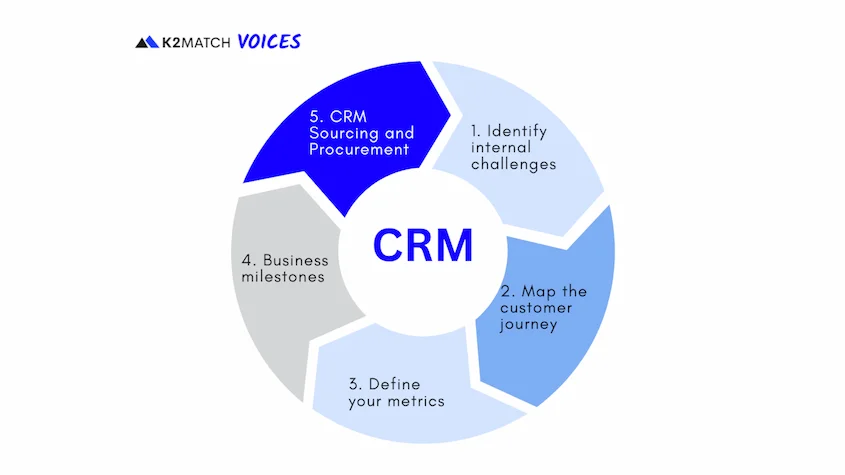
A 4-Step Evaluation Process for CRM Foundations
1. Identify internal challenges: Look for any bottlenecks and hurdles that your customer may have when buying from you, and troubleshoot ways to eliminate them. Similarly, identify areas that make it difficult for your team to communicate with prospects and customers.
2. Map the customer journey: Document how your prospects find you, interact with your brand and consume your content. Your sales process should work alongside the customer journey and guide your customers to where they need to go.
3. Define your metrics: Start by setting benchmarks for your current sales results. From here, you can identify the sales activities that will improve these KPIs.
4. Business milestones: When adopting a new CRM, be aware of any product launches and events that you’ll need to work around. Make sure these are noted in order to avoid technical hiccups.
Key Principles for Successful CRM Implementation
With this preparation complete, you’ll see how much work is required to implement your new CRM platform and processes. This will all depend on your existing processes and systems.
Essential CRM Strategy Principles:
- Vision: What will CRM integration look like across all departments?
- Culture: Is the organization primed for a customer-driven sales process?
- Journey: A well-documented map of the customer experience.
- Education: Create training material for internal teams and any third-parties involved.
- Communication: How will progress and documentation be shared?
- Leadership: Who is leading the charge? Which responsibilities lie with which team members?
- Value: How will the benefits of this CRM strategy and technology be communicated?
- Technology: An overview of the selected vendor platform and why it was chosen.
- Implementation: A documented plan of how technology and new processes will be implemented.
- Success: How will you know when the strategy has been implemented? Which KPIs will be measured?
Your CRM strategy should rely on data and communication to be implemented effectively. It all starts with understanding the customer journey.
From there on out, your CRM processes should work to enhance this journey. The strategy must also empower your sales teams. By creating a CRM strategy that helps the customer get what they want, you’re more likely to see better results from your sales activities.
How CRM Automation Optimizes the Sales Funnel
You now know how customer relationship management platforms enable sales processes, and that this is the first step to successful CRM implementation. Automation is one of the biggest benefits a CRM platform can bring. Instead of manually executing tasks such as outreach, follow-up and qualification, CRM platforms can help you automate these menial tasks. This allows sales reps to focus on the activities that bring the most impact.
This level of automation can benefit other areas of the business. For example, marketing can contribute to qualification through lead scoring. Every time a lead interacts with your brand, their score increases. Once a certain threshold is reached, that lead will go from a “marketing qualified lead” (MQL) to a “sales qualified lead” (SQL).
This is the perfect time to evaluate which stages of your sales funnel are making the biggest impact. Talk to customers who have closed in the last three to six months. Ask them what they found most valuable during their communications with you. Find out what they didn’t find of value. Customer interviews and surveys can shine a light on high-impact processes. These are the areas to be automated and optimized.
Critical Reasons to Invest in CRM Software
Customer relationship management software helps you keep on top of your clients in an automated way. Don’t rely on memory alone. Use CRM technology to store key information on your conversations. Train your sales teams to enter this information as soon as they’ve ended a call or meeting.
Not only does this lead to more efficient sales and follow-up processes, it means more data for you and your teams to collect in the long-term.
Monitoring Sales Metrics and Data In One Place
Without a CRM platform in place, you probably have multiple Excel spreadsheets set up for customer communications, sales numbers, and deal tracking. It’s good to keep track of these things, but having everything in silos can cause miscommunication between team members. With a CRM platform, all of your sales, marketing campaigns and communication data is in one place.
This will allow you to create more accurate sales forecasts and create a sales process built on a predictable revenue model.
Ensuring Data Security and GDPR Compliance
Another downside to having spreadsheets is that they are insecure. With GDPR rules in place since 2018, you could now face serious legal ramifications for not keeping customer data secure. Some CRM platforms are GDPR compliant out of the box, including Pipedrive. Everything is stored in the cloud on secure servers, meaning your data is usually safer and more secure than it would be on your local computer.
Driving Cross-Departmental Collaboration
By bringing the entire organization to a single platform, there’s one standard way of doing things and one home for the same data. Marketing can see which channels are generating leads, while sales can access that historical data to fuel their sales communications.
Improving Customer Service and Interaction Personalization
The benefits above extend to how you interact and delight your customers. As all interactions are recorded in the same place, customer service teams can see a historical view of a customer’s relationship with your brand. This insight allows customer service reps to personalize their interactions.
Unlocking CRM Benefits for Every Department
When talking about CRM, most people think of sales, but the benefits can extend to every inch of the business. It’s a tool for enhancing the entire customer experience, not just increasing sales performance. Collating and synthesizing customer data is now easy, however, we live in a world where buyers expect you to:
- Know them
- Personalize every engagement
- Teach them
- Anticipate their needs
Critical CRM Features for Sales Success
Not all CRM tools are created equally. Take the time to pick out which one your company would benefit from the most. When evaluating CRM systems, make sure they include the functionality to help your salespeople do their jobs.
Mastering Pipeline Management and Forecasting
Your sales pipeline is a visual overview of where each prospect is in the sales cycle. It helps you measure where opportunities are in the sales lifecycle and where the bottlenecks are. Great pipeline management should give you a clear visual interface that empowers reps to take the right action. It must:
- Help you act with clear intentions: Segmented by deal stage.
- Provide useful statistics: Identify which stages need improvement.
- Be fully customizable: Tailored to fit your unique sales process.
- Be intuitive: Features like drag-and-drop interfaces for ease of use.
Streamlining Communication with Email Integration
This is why the best CRMs have email functionality baked into the platform. Sync with Gmail or Outlook to send emails and schedule follow-ups on the fly. Look for:
- Email inbox sync: Real-time tracking and templates.
- Customizable templates: Quick outreach and follow-up options.
- Schedule activities: Update info without leaving the thread.
- Advanced tracking: Notifications for opens, clicks, and views.
Improving Productivity through Activity Management
Your sales activities are the things you can control the most. Revenue growth is the goal, but activity management is how you get there. Look for scheduling tools, task assignments, customizable activity types, and automated reminders.
Advanced Contact Management and Data Enrichment
The best CRM platforms give you as much insight on your customers as possible, including organization details, email tracking, and a communication timeline. Great platforms integrate contact data from social sources like LinkedIn, providing data enrichment to help personalize interactions.
Leveraging Sales Reporting and Visual Dashboards
Sales reporting should help you answer big questions, like why certain reps outperform others. A live sales dashboard provides real-time insights on deal statuses. Look for visual snapshots and customizable reports that focus on the metrics that matter most.
Accurate Sales Forecasting for Predictable Revenue
A good forecasting tool should enable reps to figure out which activities and deals to focus their efforts on. It helps you see issues arise from a mile away and alter processes preemptively.
The Step-by-Step CRM Vendor Selection Process
Select a platform that will fit your sales organization structure and help you reach your goals. Choosing the wrong vendor can be an expensive and time-consuming process to fix, so choose wisely.
Step 1: Preliminary Research and Criteria Identification
Familiarize yourself with categories like business function, cost structure, data quality, brand reputation (G2 reviews), customization flexibility, and migration simplicity.
Step 2: Create a Requirements Document
Reverse engineer and find a fit for your goals. Decide what you want to achieve first, then find the tech stack that helps you do it. Consider feature requirements like email integration and pipeline management, alongside onboarding needs.
Step 3: Evaluating Cloud vs. On-Site Solutions
Cloud CRM: Scalable, GDPR compliant out of the box, and low hardware costs. On-Premise: Full control over data and in-house management, but requires dedicated IT support.
Step 4: Define Your CRM Budget and Estimated ROI
Calculate an estimated ROI by forecasting increased productivity. Measure current sales activities and see how automation would multiply that impact. Don't forget hidden costs like training and integration.
Step 5: Evaluating Vendors: Demos, Trials, and RFPs
Request a demo, digest sales material, and use the trial period to get a feel for the platform. For larger needs, create a Request for Proposal (RFP) that outlines your objectives, essential requirements, and resource allocation.
Step 6: Making an Informed, Data-Driven Decision
Get input from the team and look at the numbers. Having a score where you measure each vendor against features and support will help you make informed decisions.
Summary: Driving Growth Through Strategic Customer Relationships
Implementing a CRM is far more than just a software installation; it is a fundamental shift toward a customer-centric business model. By integrating a clear CRM strategy with the right automation technology, organizations can break down internal silos, protect sensitive data, and empower sales teams with actionable insights. Whether you are a small startup or a growing scale-up, the transition from disorganized spreadsheets to a unified CRM platform is the key to achieving predictable revenue and long-term customer loyalty.
P.S: Thank you to our Business Partner Pipedrive for the support.