One Pitch - One Putt! Successfully Pitching Your Idea in Front of Investors

Investor Pitching Strategy: The 'One Pitch, One Putt' Approach
When you play Golf one very important shot is called "pitching". This shot is usually performed from below 100 meters from the flag. Ideally one wants to pitch the ball so close as possible to the hole for a "tap in". This would be one Pitch one Putt. The same way, when you will be pitching your idea in front of your Investors you will want your Pitch so successful that you can directly engage with the Investor. This is also one Pitch one Putt.

Identifying the Target Audience for Your Pitch
The Audience can range from family, fools and friends, over potential partners, financial institutions (Banks, Grants,...), to investors (Business angels, Family offices, VCs, Private Equity Firms).
Setting the Genuine Goal of Your Presentation
You want first to generate interest, then motivate, convince and win funders for your startup by getting them accept the next step which is a 1 on 1 deep dive meeting.
The Three Key Elements of a Successful Pitch
A successful Pitch encompasses three things:
- A well constructed story with a strong content
- Mastering your voice and body language
- Being on top of the location and the presentation technologies available
1. Mastering the Environment and Technology
When it comes to the location and technology you need to be there early enough to have a feeling of the place and check the technology available (Laptop, Software, File, Beamer, Internet access, Sound etc...)
The other recommendation for your Pitch Deck is the 10 - 20 - 30 Rule:
- 10 slides
- 20 minutes maximum
- 30 font size
- Less is more! This means less text, more schematic and pictures
- 10 slides pitch is ideal. Never more than 15 slides!
2. Utilizing Voice and Body Language Effectively
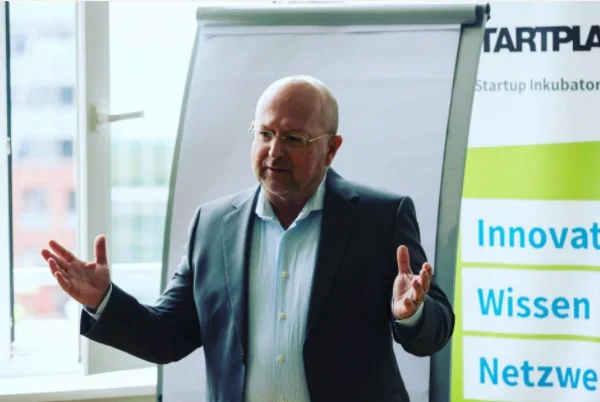
There are many trainings out there for this part. This would be too long to describe here. However your stance, the position and movement of your hands and arms and your overall movements are an important vehicle to capture the attention of your audience and to convey your message. Your voice is the most important vector for your presentation, here you will need to understand and know where to accelerate and where to slow down your tempo. You will also need to plan where to be louder and where to put voluntary put a silent pause.
3. Storytelling: Content, Structure, and Dramaturgy
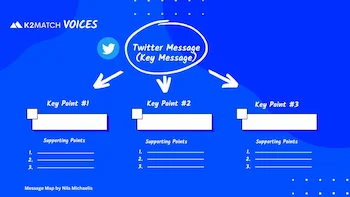
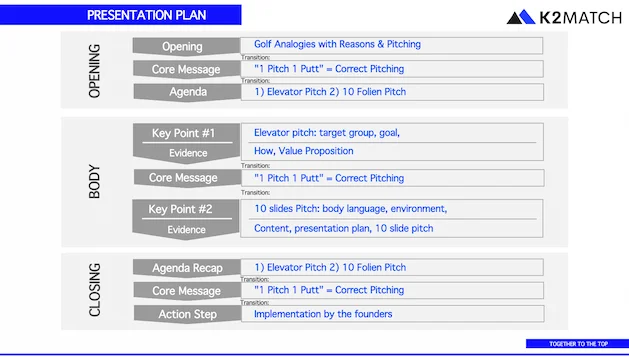
You will need to Pitch to the point with Enthusiasm and Emotion. The story line of your pitch needs to constantly capture the attention of your audience, delivering a story that delights the heart and satisfies the wallet. The audience will need to love your idea and be convinced that they can make money with it. Therefor you need a professional structure. This means a presentation plan with an opening phase, a body phase and a closing phase. You will need a core message that you repeat at the beginning of each phase.
Mastering Pitch Openings and Core Messages
Opening Techniques: Emotional vs. Analytical
It is always better to start with a beautiful and emotional story with pictures, metaphors and analogies, rather than with too many numbers - facts - data!
By doing so your Story creates Emotions resulting in Sensory impressions, leading to a message that fixes itself in the brains of your audience! The more sensory impressions are linked to the image, the better. (= The right hemisphere of the brain controls more intuition, creativity, symbols and feelings. This brain hemisphere is activated by activated by metaphors, through which the listener's own, matching images, symbols images, symbols, melodies or smells can arise).
Using Your Core Message as a Memory Aid
Your core message should be brought to the point. Your core message is like a Slogan that you will repeat in each phase of the Pitch. Remember Martin Luther King's most well-known speech where he regularly repeated his core message: "I have a dream!"
Famous Slogan Examples:
- Nike: "Just Do it"
- BMW: "Driving pleasure"
- Ritter Sport: "Square practically good"
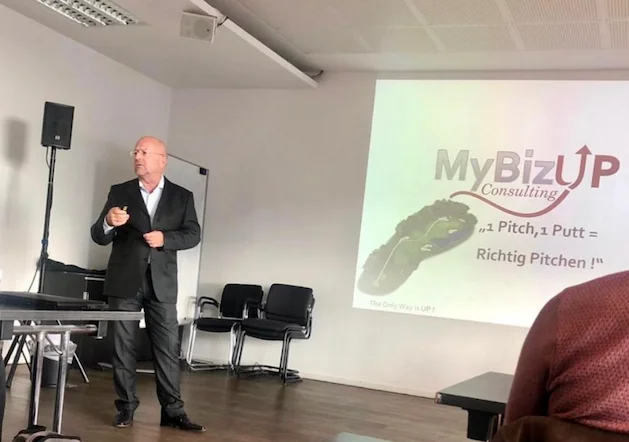
- In our Pitching Training we use: "One Pitch - One Putt"
Ask yourself what is your core message?
The 10-Slide Pitch Framework: A Proven Roadmap
To be remembered you will follow the (10-20-30 Rule). Here are the titles for each of your 10 slides:
Slide 1: Title and Contact Details
Here you mention your company name, you write your core message, your name & title, your address and contact details.
Slide 2: Identifying the Problem and Opportunity
Here you need to describe the "customer pain" that you are curing with your solution and how you are doing it. You have also the opportunity to describe the "pleasure" you are are providing your clients with your solution.
Slide 3: Defining the Value Proposition (VP)
Here you need to describe the VP = Value Proposition of your offering. How much value has the pain reduction for your client and how much value has the joy you are providing him.
Slide 4: The 'Magic' Behind Your Solution
Describe the technology, the "secret spice" or magic behind your product or solution ! Use rather little text, but more diagrams, schematics or flowcharts! If you have a picture, a prototype or a demo, this is the right moment to show or demonstrate it!
Slide 5: The Revenue and Business Model
Describe who has "your money" in his pocket at the moment and how this money will transfer to your pocket.
Slide 6: The Go-To-Market and Sales Strategy
Explain how you will reach your customers without completely raiding your war chest. Describe your Marketing Strategy & Marketing Plan, as well your Sales strategy & sales plan.
Slide 7: Comprehensive Competitive Analysis
Here you need to provide a very detailed overview of your competitive landscape. You better give too much information, rather than too little. Here you can use tools, such as the Porter's Forces and the SWOT analysis.
Slide 8: The Management Team and Advisors
Describe the key roles in your management team including advisory board, as well as your current investors.
Slide 9: Financial Forecast and Key Performance Indicators
Here you need to produce a 3 years Financial Plan (Sales numbers, Costs, Margin, Cashflow,...) not only with € values, but also with other important key figures supporting the business plan. Important key figures can be: Number of customers; conversion rates. The Forecast needs to be build based on the key performance indicators of your business first and not the other way around.
Slide 10: Current Status and Future Roadmap
Describe your current status: e.g: Status of development,... Then you describe your timeline and your needs. How will your product look like in the near future? How much money do you need? How and what for will you use the money?
Final Checklist: Common Pitching Mistakes to Avoid
- Not knowing your audience!
- Being too dependent on the slides!
- Claiming there is no competition!
- No data & facts available!
- Forgetting next steps!
Top 5 Tactics for Pitching Mastery
- Make a connection to the heart of your audience!
- Make a connection to the head (wallet) of your audience!
- Tell a Value-added story!
- Show the Team dynamics!
- Communicate to your audience that there is a lot of money to be made.
Summary: Winning the 'One Pitch, One Putt' Challenge
Mastering an investor pitch is about more than just data; it’s about aligning a compelling narrative with a disciplined 10-slide structure. By focusing on the "10-20-30 Rule," prioritizing emotional openings, and clearly defining the "magic" behind your solution, you transform a standard presentation into a powerful engagement tool. Remember: the goal of the pitch is to secure the deep-dive meeting—winning both the heart and the wallet of your audience.