Startup Business Model & Strategy: A Quick Guide

Building a Sustainable Startup Business Model Strategy
If you research the term business model on the web, you won't find a clear definition. In our guidelines, we concentrate on presenting the basic structure of your company and clearly defining your business goals and vision. The strategic decisions for your business are the basis for your business model. All other aspects of your start-up, such as marketing, opportunity and risk assessment, and financial planning result from that.
Defining Your Company Vision and Long-Term Enterprise Goals
First, formulate clear goals for the next three years and visions of where you see your company five to ten years from now. The goals you want to achieve define the requirement of your business model and your organization, which you must consider in the planning.
Strategic Planning: Questioning the 'Why' Behind Your Model
The question of "why" should always be at the forefront of all. In contrast to all questions relating to the product, the focus here is always on the strategic decisions that are associated with it.
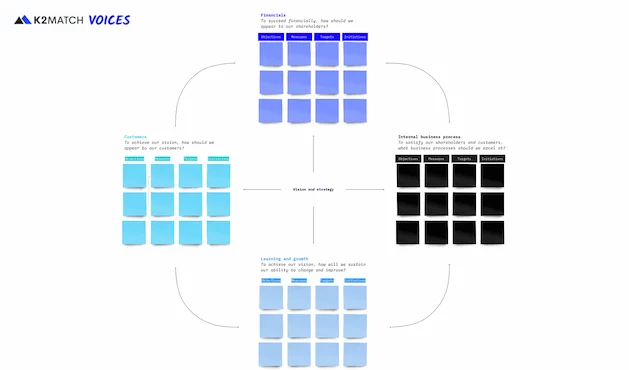
Organizational development includes, for example, the company name and, inextricably linked to this, the question of whether the name is already protected. Also, the choice of the legal form should be well considered. A possible limitation of liability for the protection of one's own person is not a sufficient reason. Why do you decide on the chosen legal form and which advantages and disadvantages, which strategic goals for the company are associated with it? Will you run the company as a sole proprietor or together with one or more partners, so that the business shares in the business must be clearly regulated?
The functional structure of your company is also important. Which organizational units are there in the company? For a better representation you can for example use an organizational chart. How do you earn money? To know if your company can work profitably, it is important to know what the money is spent on and how you want to earn it. Describe the complete value chain of your company and describe in particular the most important success factors. A central question is about your revenue model. How do you want to earn money?
Strategic Business Model Checklist:
- What is your company vision and what goals have you set for yourself? What are your most important success factors? What measures do you want to use to achieve the company's goals? What costs will be incurred?
- What is the revenue model for your product/service, i.e. how do you make your money? Do you want to be a price leader (e.g. discounter), a quality leader (e.g. delicatessen), or a specialist (e.g. teas store)?
- How is your company organized and structured? What functions does your organization include? Draw up an organizational chart. What communication channels are planned to make individual knowledge available to the entire company?
- What should your company be called and why? Is the company name protected? What legal form are you aiming for and why? Include the costs of setting up the company in your financial planning.
- Where do you plan to locate the company? Why? What are the space requirements of your company, including the requirements described in the chapter on production described in the previous chapter? What are the costs for the company location?
The Founding Team: Roles, Expertise, and Strategic Advisors
The chapter Founding Team and Key Person are usually looked at by investors directly after reading the Executive Summary. For an investor, it is important to know whether the founding team has sufficient know-how for a promising start-up.
Introducing the Founding Team and Core Responsibilities
For early-stage startups, the founding team is one of the most closely examined factors. At this stage, practical experience, the ability to work well together, and early execution wins often matter more to investors than formal academic degrees.
Be transparent about how responsibilities are currently divided within the team. Explain who is responsible for which areas today, even if roles are still evolving. Clarity is more important than perfection.
It is completely normal at an early stage that not all key roles are covered yet. What matters is that you clearly identify these gaps and explain how and when you plan to fill them, whether through future hires, advisors, or external partners.
If a critical role is currently handled by someone with limited experience, address this openly. Investors do not expect flawless teams at this stage, but they do expect self-awareness and a credible plan to strengthen the team over time.
Use the organizational chart from the previous chapter to visualize both your current structure and your planned team development. This helps readers understand where you are today and where the organization is heading.
Finally, think about resilience. What would happen if a founder or key contributor had to step back? Early-stage startups are often fragile, but showing that you have thought about knowledge transfer, documentation, and shared responsibility builds confidence.
Even at an early stage, investors want to see that the company can survive and grow beyond any single individual. Acknowledging this early is a sign of maturity, not weakness.
Strategic Advisors and Professional Support
At this point, name your most important advisors. No one comes from a home with all the qualifications and experience needed to start a business. It is a sign of professionalism to involve auditors, PR agencies, or management consultants. This professionalism reassures investors. If you outsource certain management tasks you should explain your costs and benefits.
Management Salaries and Performance-Based Compensation
Communicate openly the planned salaries for management. Use industry benchmarks as a guide. Performance-based compensation that is tied to milestones, revenue, or earnings targets makes a venture capitalist particularly confident. He can then assume that the founding team will pursue the set goals with the necessary vigor and motivation.
Founding Team Analysis:
- Who are the members of the founding team and what skills do they bring to the table? (education, practical experience, previous knowledge, successes, professional qualifications and entrepreneurial experience)? What roles do the founders assume in the company based on their qualifications? How high is the remuneration of the founders? For partnerships and individual companies: What imputed entrepreneurial wage do you plan for?
- Which experiences and skills are missing in the team and how should the gaps be filled?
- Name your most important consultants and key people. To what extent can they support you? How do you tie key people to your company? What compensation do you plan for consultants/key persons?
Personnel Planning: Recruiting and Retaining Talent
Defining Key Qualifications and Role Requirements
Your employees are more than just employees. They represent an invaluable wealth of knowledge and experience that can hardly be valued in monetary terms. It is, therefore, all the most important thing that you recruit the right employees for your company. Define the key qualifications your future employees will have.
Quantifying Personnel Requirements and Labor Costs
Draw up a personnel plan for the next three years for the individual areas of the company shown in the organization chart. In the second step, calculate the personnel costs, including non-wage labor costs, and add them to the personnel and financial planning.
Securing the Future: Long-Term Employee Retention
Finding the right employees is not the only challenge. Attracting and retaining them for the startup often requires greater effort, especially when there are initial teething problems in young companies. Since costs are incurred with every unwanted change in personnel and knowledge leaves the company, you should consider in advance how you can retain employees in the long term.
Personnel Planning Checkpoints:
- What qualifications should your employees have?
- What personnel requirements do you expect for the individual areas of your company in the next three years?
- How do you want to retain your employees in the long term?
- How high are the personnel costs including ancillary wage costs? Are you planning special bonuses? What do your personnel retention measures cost you?
Realization Roadmap: Key Growth Milestones and Timeline
A Clear Path to Market Maturity and Break-Even Point
To reach the defined milestones, certain measures are required. The realization roadmap provides an overview of the measures planned for the development of your company.
Each company phase has its own important milestones that must be reached at a certain point in time. There are technical milestones such as prototype development, organizational milestones like hiring employees, and financial milestones that provide information about your investment planning and the planned break-even point.
Again, a sound three-year plan is useful, with year one being monthly and years two and three only quarterly or semi-annually. Thematically related measures may be combined.
Roadmap and Milestone Analysis:
- What are the most important milestones in the development of your company and when do they have to be reached?
- When will you start preparing your company?
- When will you formally and legally establish the company?
- How long will it take you to reach market maturity?
- When will you go to the market?
- When will you hire your first staff?
- Which tasks and milestones are directly dependent on each other?
- When do you need what kind of financing (equity, debt or venture capital)?
- When will you reach the Break Even Point?
- Display all milestones in a bar chart over time (Gantt chart).
Summary: Strengthening Your Business Model and Team for Investor Readiness
Defining a robust business model is the foundation upon which your entire startup is built. By clearly articulating your vision, assembling a highly qualified founding team, and mapping out a realistic milestones roadmap, you create a narrative of professional readiness that resonates with investors. Effective personnel planning and strategic advisors ensure that your organization remains resilient as you scale toward market maturity and your break-even point.